

-
nimda
- May 25, 2026
Search engines are one of the most important discovery systems on the internet. Every day, billions of searches are performed by users trying to learn something, solve a problem, compare options, or make a decision.
How SEO Helps Businesses Grow is fundamentally about how a website becomes part of this discovery system. SEO is not simply about ranking higher—it is about making a website understandable, relevant, and trustworthy in the way search engines interpret information.
When a website aligns properly with search behavior and search engine evaluation systems, it can generate consistent organic visibility that supports long-term business growth.
This article explains SEO from a system-level perspective, focusing on how growth actually happens inside search engines, not just what SEO does on the surface.
Understanding SEO as a Search Visibility System
SEO (Search Engine Optimization) is best understood as a visibility alignment system between three core elements:
- User search behavior
- Website content structure
- Search engine understanding systems
Instead of pushing traffic through ads or promotions, SEO works by making content discoverable when users express intent through search queries.
Search engines do not “show websites randomly.” They evaluate pages based on relevance signals, structure, authority, and usefulness compared to other competing pages.
When these signals are strong and consistent, a website becomes eligible for higher visibility across multiple search queries.
How Search Engines Actually Process SEO Signals
To understand how SEO drives growth, it is important to understand how search engines process information:
1. Crawling (Discovery Layer)
Search engines first discover pages by scanning links and website structures.
If a page is not easily accessible or properly linked, it may never enter the system.
2. Indexing (Understanding Layer)
Once discovered, search engines analyze the page content to understand:
- What the page is about
- Which topics it belongs to
- How it relates to other content
This stage is where semantic understanding begins.
3. Ranking (Comparison Layer)
Search engines compare multiple pages targeting the same intent and decide which ones best satisfy user needs.
Ranking is not based on one factor—it is based on a combination of relevance, authority, clarity, and content depth.
4. Re-ranking (Behavior Feedback Layer)
Over time, search engines adjust rankings based on user behavior signals such as:
- Click-through behavior
- Engagement patterns
- Content satisfaction indicators
This makes SEO a continuous evaluation system, not a one-time setup.
Search Intent: The Core Driver of SEO Growth
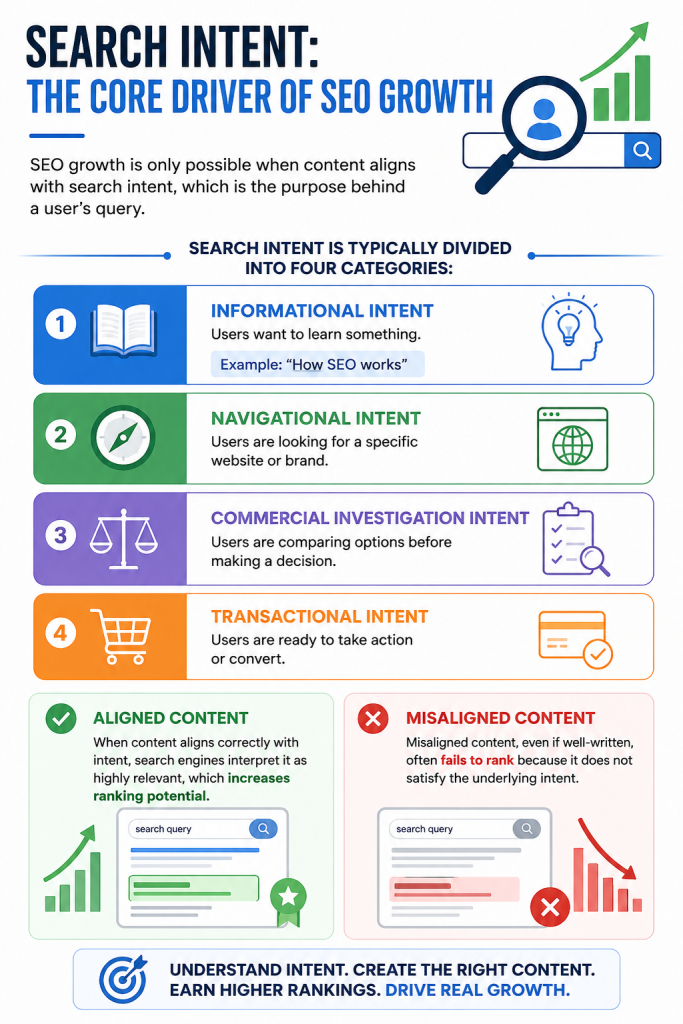
SEO growth is only possible when content aligns with search intent, which is the purpose behind a user’s query.
Search intent is typically divided into four categories:
1. Informational Intent
Users want to learn something.
Example: “How SEO works”
2. Navigational Intent
Users are looking for a specific website or brand.
3. Commercial Investigation Intent
Users are comparing options before making a decision.
4. Transactional Intent
Users are ready to take action or convert.
When content aligns correctly with intent, search engines interpret it as highly relevant, which increases ranking potential.
Misaligned content, even if well-written, often fails to rank because it does not satisfy the underlying intent.
Why SEO Creates Sustainable Business Growth
SEO contributes to growth through compounding visibility effects.
Each optimized page becomes a long-term entry point into a website. Unlike paid ads that stop when budgets end, SEO content continues to generate traffic as long as it remains relevant.
This creates a growth cycle:
- More optimized pages → more indexed entry points
- More entry points → higher visibility coverage
- Higher visibility → more organic traffic
- More traffic → more behavioral data → improved rankings
Over time, this system compounds into stable and scalable growth.
Topic Clusters and Semantic Authority
Modern SEO is no longer based on individual pages ranking alone. It is based on topic clusters.
A topic cluster is a group of interconnected content pieces that collectively cover a subject in depth.
Search engines evaluate:
- How well a topic is covered across multiple pages
- How content is internally connected
- Whether the website demonstrates semantic depth
For example, a strong SEO knowledge system may include connected content about:
- Search intent
- Keyword cannibalization
- Technical SEO
- Semantic SEO
- Content optimization
When these topics are structurally connected, search engines recognize the site as a topical authority, improving ranking potential across the entire cluster.
Technical SEO as the Foundation Layer
Technical SEO ensures that search engines can properly access, interpret, and evaluate a website.
Without a strong technical foundation, even high-quality content may not perform well.
Key technical factors include:
- Crawl accessibility
- Indexing control
- Site structure clarity
- Internal linking architecture
- Page performance and usability
These elements do not directly create rankings, but they determine whether content can be properly evaluated in the first place.
Content Relevance and Semantic Depth
Search engines evaluate content not just by keywords, but by meaning and context.
Semantic SEO focuses on:
- Topic coverage depth
- Concept relationships
- Contextual clarity
- Entity relevance
A page that fully explains a topic with clear structure and supporting sub-concepts is more likely to rank than a shallow page with keyword repetition.
This is because search engines attempt to match user intent with the most complete and helpful explanation available.
Ranking Signals That Influence SEO Growth
SEO performance is influenced by multiple ranking signals working together:
- Content relevance to query intent
- Topical authority of the website
- Internal linking structure
- External authority signals (backlinks)
- User engagement behavior
- Content clarity and depth
No single factor determines ranking alone. Search engines evaluate the overall quality and trustworthiness of the page within its topic ecosystem.
The Compounding Nature of SEO Growth
One of the most important characteristics of SEO is compounding growth.
As more content is published and optimized:
- The website gains broader topical coverage
- Search engines understand the site better
- More pages start ranking for related queries
This leads to exponential—not linear—growth over time.
Unlike short-term marketing channels, SEO strengthens as the content ecosystem expands.
Common Misunderstandings About SEO Growth
1. SEO is instant
SEO is a long-term system. It requires time for content to be crawled, evaluated, and tested.
2. SEO is just keywords
Modern SEO is based on meaning, intent, and structure—not keyword repetition.
3. More content guarantees rankings
Content must be relevant, structured, and aligned with search intent to perform well.
4. SEO is a one-time setup
SEO is continuously evaluated based on competition, content freshness, and user behavior.
Internal Linking as a Knowledge System
Internal linking is not just navigation—it is a meaning distribution system.
It helps search engines understand:
- Which pages are related
- How topics are connected
- Which content is most authoritative within a cluster
For example:
- Search intent connects to keyword research
- Technical SEO connects to crawling and indexing
- Content relevance connects to semantic SEO
This structure strengthens the overall authority of a website rather than isolated pages.
Final Thoughts
SEO is not simply a traffic strategy. It is a structured system that connects user intent with content through search engine evaluation mechanisms.
How SEO Helps Businesses Grow can be summarized as the process of building long-term visibility through relevance, structure, and trust.
When properly implemented, SEO creates a sustainable ecosystem where:
- Users naturally discover content
- Search engines consistently understand relevance
- Visibility compounds over time
Instead of forcing attention, SEO aligns content with demand—allowing growth to emerge naturally through search-driven discovery.