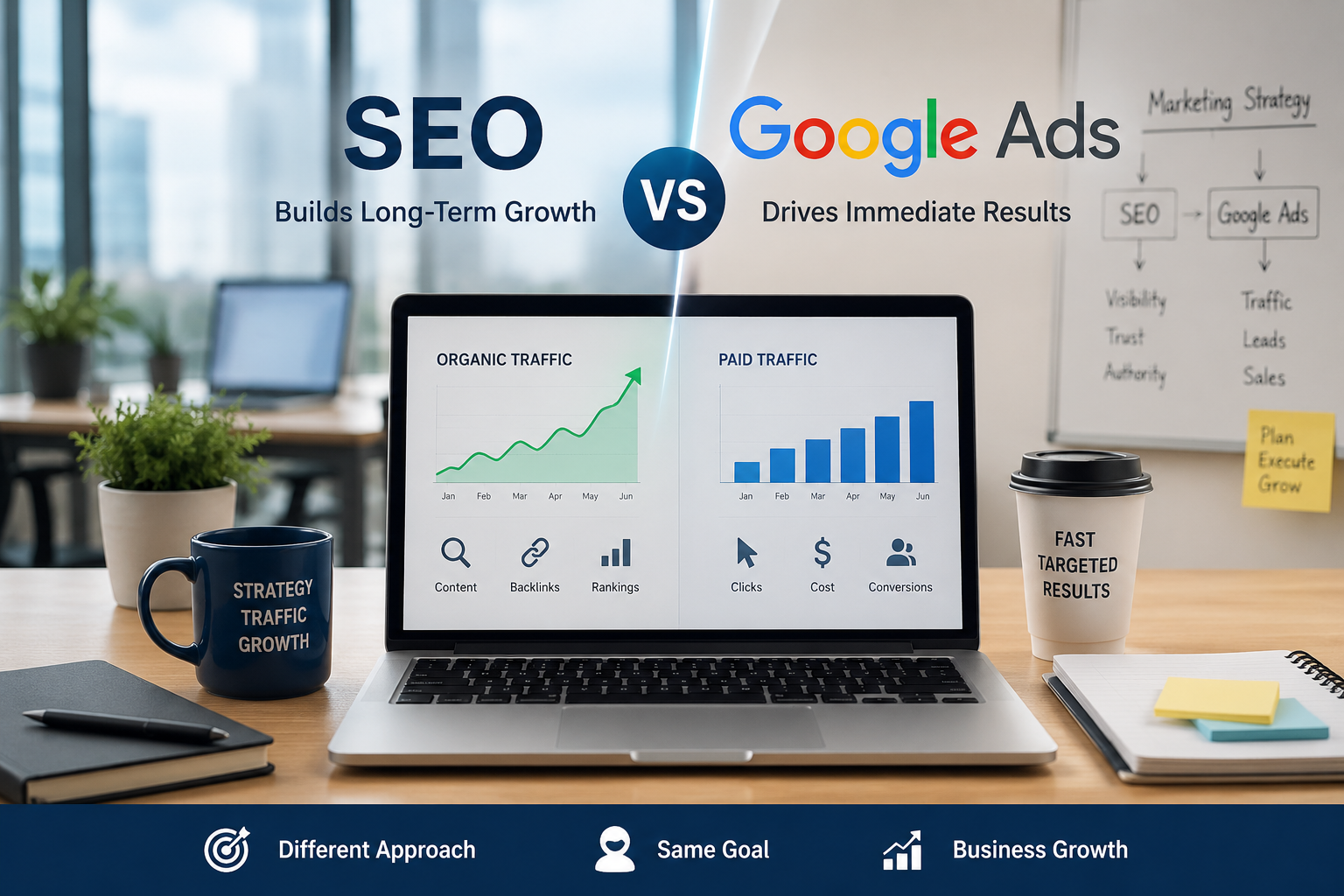
Businesses trying to grow online often face the same question: should they invest in SEO or Google Ads?
At first glance, both appear to solve the same problem — getting visibility on Google. In reality, they operate on completely different growth models.
SEO builds long-term visibility gradually through relevance, authority, and content quality. Google Ads purchases immediate visibility through advertising systems and bidding mechanisms.
Understanding this difference is important because many businesses choose the wrong channel based on unrealistic expectations. Some expect SEO to produce instant traffic, while others become permanently dependent on paid advertising without building sustainable organic visibility.
The right strategy depends on:
- business goals
- competition level
- timeline expectations
- budget flexibility
- customer search behavior
- search intent
This article explains SEO vs Google Ads in depth, including how they work, where they perform best, their limitations, and how businesses often combine both for balanced search growth.
Understanding the Core Difference
The biggest difference between SEO and Google Ads is simple:
- SEO earns visibility organically
- Google Ads buys visibility through paid placements
SEO focuses on improving a website so search engines rank it naturally in organic search results over time.
Google Ads allows businesses to appear immediately at the top of search results by paying for clicks through keyword bidding systems.
Although both generate search engine traffic, the underlying mechanics are entirely different.
What Is SEO?
SEO (Search Engine Optimization) is the process of improving a website’s visibility in organic search results.
Organic rankings are earned based on multiple factors, including:
- content quality
- search intent relevance
- topical authority
- internal linking
- technical accessibility
- user experience
- backlink authority
- semantic relationships
- indexing efficiency
Search engines evaluate whether pages genuinely satisfy user intent and provide valuable information.
SEO is not a one-time action. It is a long-term process of helping search engines better understand, trust, and prioritize a website within a topic area.
The goal is to appear naturally when users search for relevant questions, products, services, or information.
What Are Google Ads?
Google Ads is Google’s paid advertising platform that allows businesses to appear in sponsored search placements.
These ads usually appear above organic results and are labeled as “Sponsored.”
Advertisers bid on keywords, and Google determines ad placement using factors such as:
- bid amount
- Quality Score
- ad relevance
- expected click-through rate (CTR)
- landing page experience
- competition level
Unlike SEO, paid visibility exists only while campaigns remain active.
Once ad spending stops, traffic typically stops as well.
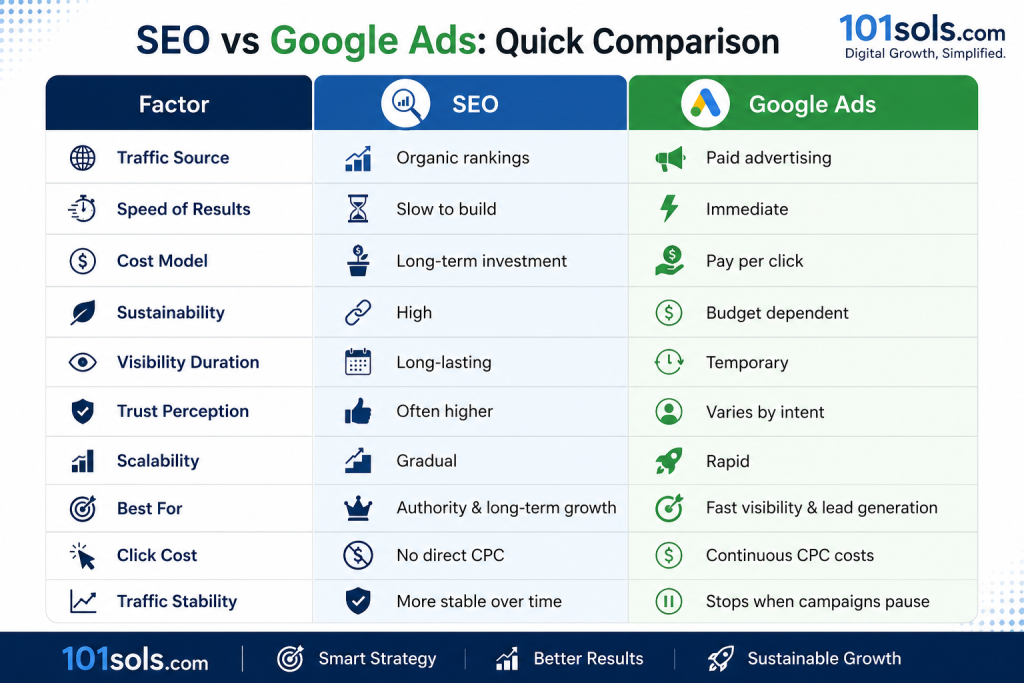
SEO vs Google Ads: Quick Comparison
| Factor | SEO | Google Ads |
|---|
| Traffic Source | Organic rankings | Paid advertising |
| Speed of Results | Slow to build | Immediate |
| Cost Model | Long-term investment | Pay per click |
| Sustainability | High | Budget dependent |
| Visibility Duration | Long-lasting | Temporary |
| Trust Perception | Often higher | Varies by intent |
| Scalability | Gradual | Rapid |
| Best For | Authority & long-term growth | Fast visibility & lead generation |
| Click Cost | No direct CPC | Continuous CPC costs |
| Traffic Stability | More stable over time | Stops when campaigns pause |
How SEO Traffic Works
SEO traffic is earned gradually.
Search engines continuously evaluate:
- content usefulness
- semantic relevance
- user engagement
- authority signals
- backlink quality
- topical depth
- website performance
When pages consistently satisfy search intent better than competitors, rankings improve over time.
This creates a compounding growth effect.
A strong article may continue generating traffic for years without paying for every visitor individually.
This is one reason SEO is often viewed as a long-term digital asset rather than a short-term campaign.
How Google Ads Traffic Works
Google Ads generates traffic almost immediately after campaigns go live.
Advertisers choose:
- keywords
- bidding strategies
- audience targeting
- geographic settings
- ad copy
- campaign budgets
When users search targeted keywords, ads may appear instantly.
This creates fast visibility, which is why Google Ads is commonly used for:
- product launches
- seasonal promotions
- immediate lead generation
- urgent service businesses
- competitive commercial searches
However, every click has a direct acquisition cost.
Traffic disappears quickly when campaigns stop running.
SEO vs Google Ads: Speed of Results
SEO
SEO usually starts slowly because search engines need time to:
- crawl pages
- process content
- evaluate quality
- compare competing pages
- understand topical relationships
- measure engagement patterns
In competitive industries, meaningful ranking growth may take several months.
However, rankings often become more stable and cost-efficient over time.
Google Ads
Google Ads delivers immediate exposure.
Campaigns can start generating impressions, clicks, and conversions within hours.
This makes paid advertising attractive for businesses needing:
- fast traffic
- quick testing
- rapid customer acquisition
- immediate market visibility
The tradeoff is ongoing spending dependency.
The Customer Journey Difference
One of the most important differences between SEO and Google Ads is how they support different stages of the search journey.
SEO Dominates Early Research Stages
SEO performs strongly when users are:
- learning
- researching
- comparing
- exploring problems
- seeking educational information
Examples:
- “How SEO works”
- “Why websites lose rankings”
- “What affects Google rankings”
These searches usually involve informational intent.
Users often prefer detailed organic content because it feels more trustworthy and educational.
Google Ads Dominates High-Intent Searches
Google Ads often performs strongly when users are ready to act immediately.
Examples:
- “Buy CRM software”
- “Emergency plumber near me”
- “Best accounting software pricing”
These searches often involve transactional or commercial intent.
In urgent situations, users frequently click paid ads because speed matters more than research depth.
Long-Term Sustainability
This is where SEO and Google Ads differ most significantly.
SEO Builds Long-Term Assets
SEO content can continue attracting traffic long after publication.
A well-optimized page may generate:
- ongoing organic traffic
- backlinks
- brand visibility
- authority signals
- internal linking strength
- recurring leads
Over time, this creates cumulative growth.
As topical authority expands, newer pages may also rank faster.
Google Ads Requires Continuous Spending
Google Ads creates rented visibility rather than owned visibility.
Traffic stops when:
- campaigns pause
- budgets run out
- bids become uncompetitive
- ad accounts change strategy
This makes paid advertising highly controllable but less sustainable without ongoing budget allocation.
Cost Differences Between SEO and Google Ads
SEO Costs
SEO investment commonly includes:
- content production
- technical optimization
- research
- UX improvements
- content updates
- internal linking
- authority building
Although SEO requires resources, there is no direct cost per click.
Over time, the average customer acquisition cost may decrease significantly if rankings stabilize.
Google Ads Costs
Google Ads operates on a pay-per-click model.
Costs depend on:
- keyword competition
- bidding pressure
- industry demand
- Quality Score
- conversion competition
- audience targeting
In highly competitive industries, clicks can become extremely expensive.
This means profitability depends heavily on:
- conversion rates
- landing page quality
- offer strength
- audience targeting efficiency
User Trust and Click Behavior
Many users consciously distinguish between ads and organic rankings.
During research-focused searches, users often trust organic results more because they appear earned rather than purchased.
However, click behavior changes depending on urgency and intent.
For example:
- educational searches often favor organic content
- urgent transactional searches frequently favor paid ads
- branded searches may generate clicks across both
Search intent strongly influences whether SEO or Google Ads receives better engagement.
SEO vs Google Ads for New Websites
New websites often struggle to gain immediate organic visibility because they lack:
- authority
- backlinks
- topical depth
- historical trust signals
- indexed content volume
In these situations, Google Ads can provide immediate exposure while SEO foundations develop gradually.
Many businesses use paid advertising early while building long-term organic assets simultaneously.
Over time, SEO may reduce dependency on paid acquisition channels.
Competition Dynamics
SEO Competition
SEO competition depends heavily on:
- content quality
- semantic depth
- topical authority
- backlink trust
- technical performance
- search intent alignment
Winning rankings often requires stronger overall expertise and relevance than competitors.
Google Ads Competition
Google Ads competition depends on:
- bid strategy
- ad quality
- Quality Score
- budget strength
- conversion performance
- CTR optimization
Businesses with larger budgets can often scale visibility quickly, especially in highly commercial industries.
Measuring ROI
Both SEO and Google Ads can produce strong returns, but the measurement models differ.
SEO ROI
SEO ROI is commonly evaluated using:
- organic traffic growth
- ranking improvements
- lead generation
- assisted conversions
- engagement metrics
- long-term acquisition efficiency
Because SEO compounds over time, long-term ROI can become extremely efficient.
Google Ads ROI
Google Ads ROI is usually measured more directly through:
- cost per click (CPC)
- conversion rate
- cost per acquisition (CPA)
- return on ad spend (ROAS)
- campaign profitability
Paid advertising allows faster performance attribution because data appears quickly.
Common Business Mistakes
Many businesses misunderstand how SEO and Google Ads actually work.
Expecting SEO to Produce Instant Results
SEO is a long-term growth system.
Businesses that expect immediate rankings often abandon SEO before momentum develops.
Relying Only on Paid Advertising Forever
Some companies depend entirely on ads without building organic visibility.
This creates long-term acquisition dependency and rising advertising costs.
Ignoring Landing Page Experience
Even strong ad campaigns fail when landing pages:
- load slowly
- lack clarity
- mismatch user intent
- create friction
Traffic alone does not guarantee conversions.
Treating SEO as “Free Traffic”
SEO avoids direct CPC costs, but it still requires:
- strategic planning
- consistent publishing
- optimization
- technical maintenance
- content improvement
When SEO Makes More Sense
SEO is often more suitable when the goal is:
- long-term traffic growth
- educational visibility
- authority building
- recurring organic acquisition
- sustainable search visibility
SEO becomes especially powerful in industries where informational searches generate ongoing demand.
Examples include:
- software education
- digital marketing
- health information
- finance education
- publishing ecosystems
When Google Ads Makes More Sense
Google Ads is often more practical when businesses need:
- immediate traffic
- rapid testing
- fast lead generation
- seasonal campaign visibility
- urgent customer acquisition
For example, emergency service businesses may rely heavily on paid visibility because users need immediate solutions.
Why Many Businesses Use Both
SEO and Google Ads are not always competing systems.
In many cases, they complement each other.
Businesses commonly combine them because each solves different acquisition problems.
For example:
- SEO builds long-term authority
- Google Ads provides immediate scalability
Paid campaigns may also reveal:
- high-converting keywords
- audience behavior patterns
- conversion data
- messaging effectiveness
These insights can strengthen SEO strategy over time.
Meanwhile, strong organic visibility may reduce long-term advertising dependency.
This combination often creates a more balanced and resilient search acquisition system.
Strategic Reality: SEO Builds Assets, Ads Rent Visibility
The real difference between SEO and Google Ads is deeper than “free vs paid.”
SEO builds long-term visibility assets through:
- authority
- trust
- semantic relevance
- topical depth
- accumulated rankings
Google Ads rents visibility temporarily through:
- bidding systems
- advertising budgets
- keyword competition
- campaign optimization
One compounds gradually.
The other scales immediately.
Understanding this distinction is essential when planning long-term digital growth strategies.
Frequently Asked Questions
Is SEO better than Google Ads?
Neither is universally better.
SEO is often stronger for long-term authority and sustainable traffic, while Google Ads is stronger for immediate visibility and fast lead generation.
Is SEO cheaper than Google Ads?
SEO usually becomes more cost-efficient over time because traffic can continue after content is published.
Google Ads requires continuous spending for ongoing visibility.
Do Google Ads improve SEO rankings?
No.
Google separates paid advertising systems from organic ranking systems.
Running ads does not directly improve SEO rankings.
Which is better for small businesses?
It depends on business goals, competition, and urgency.
Some small businesses benefit from immediate paid visibility, while others gain stronger long-term value from organic search growth.
How long does SEO take compared to Google Ads?
Google Ads can generate traffic almost immediately.
SEO may take several months before meaningful ranking growth appears, especially in competitive industries.
Final Thoughts
SEO and Google Ads solve different search visibility problems.
SEO focuses on:
- long-term authority
- sustainable traffic growth
- organic visibility
- topical relevance
Google Ads focuses on:
- immediate exposure
- controllable traffic acquisition
- rapid scalability
- short-term visibility
Neither strategy exists in isolation.
The right approach depends on:
- business objectives
- search intent
- timeline expectations
- acquisition costs
- market competition
- customer behavior
For many organizations, the strongest strategy is not choosing one over the other, but understanding how each contributes to different stages of online growth.