

-
nimda
- May 29, 2026
SEO is one of the most effective long-term strategies for building organic visibility, but it is also one of the most misunderstood.
Many website owners expect rankings and traffic immediately after publishing content or optimizing pages. In reality, SEO is a gradual process because search engines need time to crawl, index, evaluate, compare, and trust a website before consistently improving its visibility in search results.
This often leads to one of the most common questions in search engine optimization:
How long does SEO actually take?
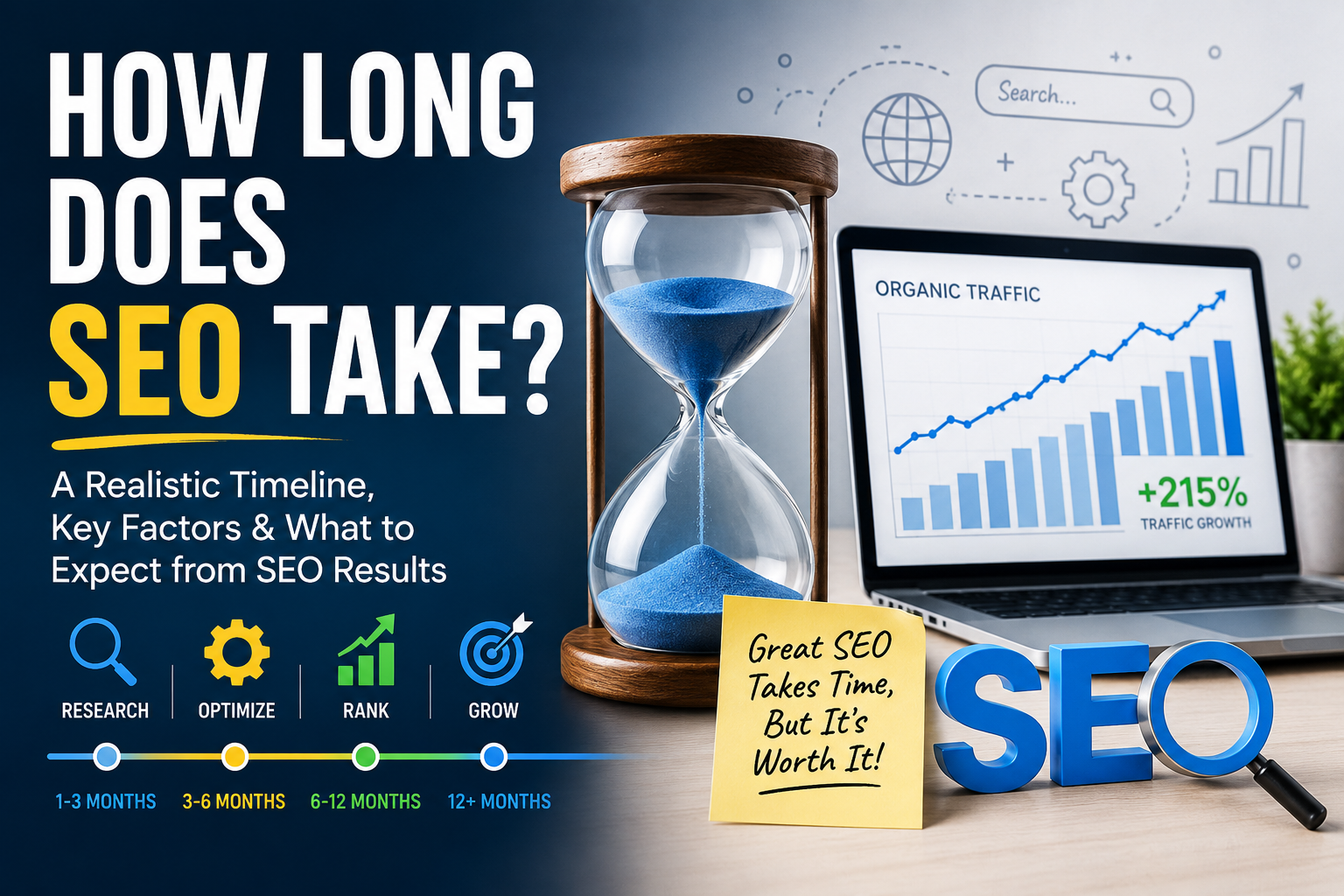
In most cases, websites begin seeing early SEO signals within 3 to 6 months, while meaningful traffic growth and competitive rankings may take anywhere from 6 to 12 months or longer depending on the website, industry, competition level, and overall SEO quality.
SEO timelines are not fixed because search visibility depends on many interconnected factors, including:
Content quality
Search intent alignment
Technical SEO health
Website authority
Internal linking
Competition level
Crawl efficiency
Backlink quality
Topical depth
User experience signals
Understanding why SEO takes time helps create realistic expectations and prevents businesses from abandoning optimization efforts too early.
So, How Long Does SEO Take?
Most websites start noticing small SEO improvements within the first few months, but sustainable ranking growth usually develops gradually over time.
Typical SEO progression often looks like this:
| Timeline | Common SEO Developments |
|---|---|
| Month 1 | Research, audits, technical fixes, content planning |
| Months 2–3 | Increased impressions, indexing improvements, long-tail visibility |
| Months 3–6 | Ranking growth, organic traffic increases, stronger crawl activity |
| Months 6–12 | Authority development, competitive keyword movement, traffic consistency |
| 12+ Months | Strong topical authority and long-term organic growth potential |
The exact timeline depends heavily on the competitiveness of the industry and the overall quality of SEO implementation.
Why SEO Takes Time
SEO takes time because search engines continuously evaluate websites before increasing their visibility in search engine results pages (SERPs).
Unlike paid advertising, SEO is not an instant visibility system.
Search engines must first:
Discover pages
Crawl content
Understand topical relevance
Analyze semantic relationships
Evaluate search intent satisfaction
Compare pages against competitors
Measure engagement patterns
Assess authority signals
Reevaluate rankings over time
This process happens gradually across multiple crawls and algorithmic evaluations.
Even well-optimized pages may require time before search engines fully trust their quality and relevance.
SEO Is a Process, Not an Instant Ranking Switch
One of the biggest misconceptions about SEO is that rankings should improve immediately after optimization.
In reality, SEO behaves more like a cumulative growth system.
Small improvements build on each other over time through:
Better content relationships
Stronger internal linking
Increased crawl efficiency
Improved user engagement
Growing topical relevance
Expanding keyword visibility
Authority reinforcement
Many websites experience slow early growth before momentum begins compounding.
This is especially common for websites building topical authority from the ground up.
The Typical SEO Timeline Explained
Although every website behaves differently, SEO growth often follows predictable stages.
Month 1: Research, Auditing, and Foundation Work
The first month of SEO usually focuses on preparation and infrastructure improvements rather than immediate ranking gains.
This stage may include:
Technical SEO audits
Crawl analysis
Keyword research
Search intent mapping
Content planning
Internal linking improvements
Metadata optimization
Site structure refinement
Mobile usability fixes
Indexing corrections
For many websites, search engines begin recrawling updated pages during this stage, but significant ranking movement is usually limited.
For newer websites, this phase is critical because search engines still have minimal historical trust signals.
Months 2 to 3: Early Visibility Signals
After foundational optimization is implemented, websites may begin seeing early SEO indicators.
These signals often include:
Increased search impressions
Growth in indexed pages
Long-tail keyword visibility
Higher crawl frequency
Expanded keyword diversification
Improved average positions
Better click-through opportunities
Traffic may still remain relatively modest during this stage, especially in competitive industries.
However, these early signals often indicate that search engines are beginning to better understand the site’s topical relevance and content relationships.
Many websites see impressions increase before clicks significantly improve.
Months 3 to 6: Measurable SEO Growth
For many websites, this is the stage where meaningful SEO growth becomes visible.
Possible improvements include:
Higher keyword rankings
Increased organic clicks
Better SERP visibility
Improved content discovery
Stronger internal page performance
More stable ranking patterns
Search engines may also begin recognizing broader topical depth across multiple semantically related pages.
Websites that consistently publish useful, well-structured content often perform better because search engines can more confidently evaluate expertise and subject relevance.
At this stage, unresolved technical issues may begin limiting further growth.
Months 6 to 12: Authority Development
As websites continue building quality signals, SEO performance often becomes more stable and scalable.
This period may include:
Competitive keyword improvements
Increased domain trust
Faster indexing of new pages
More consistent traffic growth
Stronger semantic relevance
Higher engagement signals
Improved authority across topic clusters
Older content may also begin performing better as internal linking systems strengthen topical relationships across the website.
Some websites experience accelerated growth during this stage because SEO improvements often compound over time.
Why SEO Results Often Compound Over Time
SEO is cumulative.
As content ecosystems expand, search engines gain more contextual understanding of a website’s expertise, relevance, and topical relationships.
This creates a compounding effect where:
Existing pages strengthen newer pages
Internal links distribute authority signals
Long-tail rankings expand naturally
Crawl paths improve
Topical clusters become clearer
Search engines develop stronger confidence in the website
A single high-quality article may rank independently, but a connected ecosystem of semantically related content often performs significantly better over the long term.
This is one reason topical authority strategies frequently outperform isolated keyword targeting approaches.
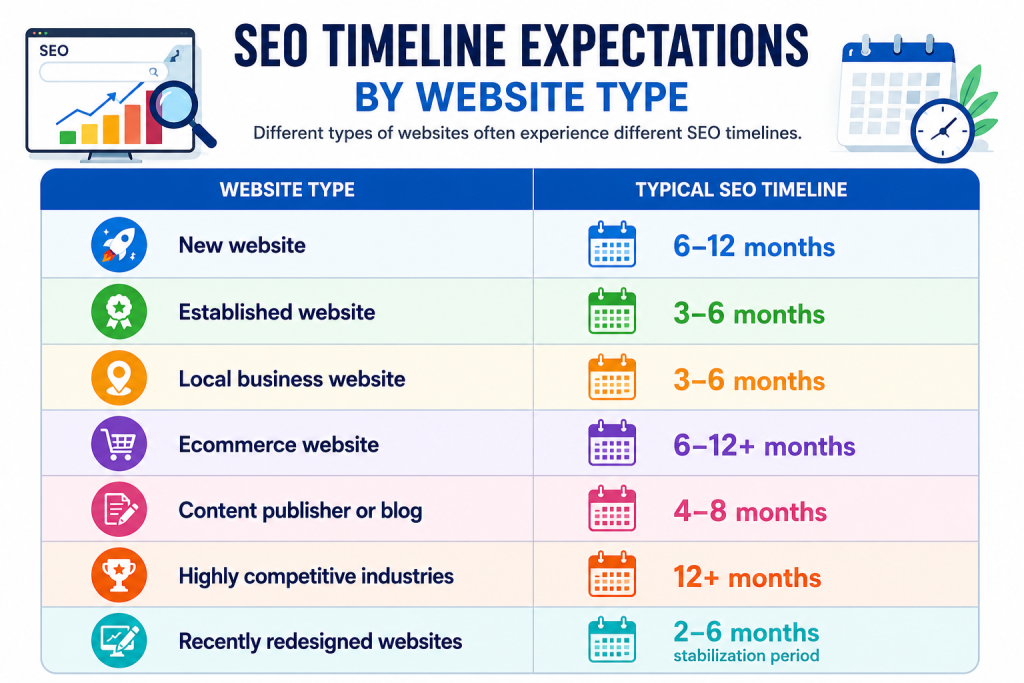
SEO Timeline Expectations by Website Type
Different types of websites often experience different SEO timelines.
| Website Type | Typical SEO Timeline |
|---|---|
| New website | 6–12 months |
| Established website | 3–6 months |
| Local business website | 3–6 months |
| Ecommerce website | 6–12+ months |
| Content publisher or blog | 4–8 months |
| Highly competitive industries | 12+ months |
| Recently redesigned websites | 2–6 months stabilization period |
These timelines are general estimates rather than guarantees.
SEO progress depends heavily on implementation quality, competition, crawlability, and content relevance.
Why New Websites Usually Take Longer
New websites often require additional time because they lack historical authority and trust signals.
Search engines typically have limited information about:
Content reliability
User engagement quality
Topical expertise
Link profile trust
Consistency patterns
New domains may also have:
Smaller content footprints
Weak internal linking systems
Limited backlinks
Reduced crawl frequency
Minimal brand recognition
This does not mean new websites cannot rank early.
Low-competition topics and highly focused content can still perform relatively quickly when search intent alignment is strong.
However, broader authority development usually requires more time.
SEO Is Different Across Industries
Industry competition plays a major role in SEO timelines.
Some industries are naturally more competitive because many authoritative websites compete for the same search demand.
Examples include:
Healthcare
Finance
Legal
SaaS
Insurance
Ecommerce
These industries often require:
Greater content depth
Stronger authority signals
Higher backlink quality
More advanced topical coverage
Meanwhile, niche informational topics or localized subjects may achieve visibility much faster due to lower competition levels.
Factors That Affect How Fast SEO Works
Several variables influence how quickly SEO improvements appear.
Competition Level
Competitive keywords usually require more time because search engines already trust existing high-authority pages.
Broad search queries are typically harder to rank for than highly specific or niche-focused searches.
Content Quality
Search engines increasingly prioritize useful, relevant, and search-intent-focused content.
Thin or repetitive content can slow overall SEO performance.
Pages that clearly satisfy user intent tend to perform better over time.
Technical SEO Health
Technical barriers can delay crawling, indexing, and ranking improvements.
Common technical issues include:
Broken internal links
Duplicate content
Poor mobile usability
Slow loading pages
Crawl restrictions
Indexing errors
Weak site architecture
Even excellent content may struggle if search engines cannot efficiently access or understand pages.
Internal Linking Structure
Internal linking helps search engines understand relationships between pages.
Strong internal linking can improve:
Crawl efficiency
Topical clarity
Authority distribution
Page discovery
Semantic relationships
Weak internal linking often slows content visibility growth.
Backlink Quality
Backlinks remain an important trust signal.
Relevant, natural backlinks may help accelerate authority development, while manipulative link practices can create long-term ranking instability.
Search engines evaluate both relevance and quality rather than raw link quantity alone.
Content Consistency
SEO generally rewards sustained quality over short bursts of activity.
Websites that continuously improve and expand their topical ecosystem often build stronger long-term authority.
Common Reasons SEO Takes Longer Than Expected
Many websites delay their own SEO progress without realizing it.
Common problems include:
Weak Topical Depth
Publishing isolated articles without broader topical relationships can reduce contextual authority.
Poor Search Intent Alignment
Content that does not match what users actually expect may struggle to rank consistently.
Thin Content Quality
Short, repetitive, or low-value content often lacks the depth needed to compete effectively.
Inconsistent Publishing
Large gaps in content development can slow momentum and crawl activity.
Technical SEO Problems
Indexing issues, crawl inefficiencies, and site performance problems may limit visibility.
Weak User Experience
Poor usability, intrusive layouts, or confusing navigation can negatively affect engagement signals.
Unrealistic Keyword Targeting
Many websites target highly competitive keywords before developing sufficient authority.
Early SEO Signals Before Traffic Growth
SEO progress often becomes visible before major traffic increases occur.
Important early indicators include:
Increased Google Search Console impressions
Growth in indexed pages
Higher crawl frequency
Improved keyword spread
Better average ranking positions
Expanded long-tail visibility
Increased SERP appearances
Many websites experience gradual visibility expansion before significant click growth develops.
This is normal during the SEO maturation process.
Why SEO Growth Is Rarely Linear
SEO performance does not typically improve in a perfectly steady pattern.
Websites may experience:
Temporary ranking drops
Visibility plateaus
Sudden traffic spikes
Algorithm-related fluctuations
Delayed indexing changes
Core update reevaluations
Search engines continuously reassess content quality, relevance, freshness, and competition.
Because of this, SEO performance should usually be measured over months rather than days.
Common Misconceptions About SEO Timelines
“SEO Should Work Immediately”
Search engines require time to process, evaluate, and compare pages.
Immediate rankings are uncommon outside very low-competition searches.
“Publishing More Content Guarantees Faster Results”
Content volume alone is not enough.
Search engines prioritize usefulness, topical relevance, and intent satisfaction more than sheer quantity.
“More Keywords Means Better Rankings”
Keyword stuffing can reduce content clarity and negatively affect quality signals.
Natural semantic relevance is more important than repetitive keyword usage.
“SEO Stops Once Rankings Improve”
SEO is ongoing.
Competitors continue optimizing their content, search behavior evolves, and algorithms change regularly.
Long-term SEO visibility requires ongoing refinement.
Setting Realistic SEO Expectations
A realistic SEO mindset focuses on sustainable authority building rather than instant rankings.
In many cases:
Smaller websites may need longer trust-building periods
Competitive industries require greater depth and authority
Technical recovery projects often stabilize gradually
Content ecosystems strengthen over time
Organic visibility compounds through consistency
SEO works best when treated as a long-term visibility and knowledge-building strategy rather than a quick traffic tactic.
Final Thoughts
SEO takes time because search engines continuously evaluate websites through crawling, indexing, semantic analysis, authority assessment, and relevance reevaluation.
While some improvements may appear relatively quickly, sustainable organic growth usually develops gradually over several months or longer.
The exact timeline depends on factors such as competition level, technical SEO health, content quality, search intent alignment, internal linking, topical authority, and overall website trust signals.
Websites that consistently build useful content, strong semantic relationships, technical accessibility, and positive user experiences are more likely to achieve stable long-term SEO growth.
Rather than expecting immediate rankings, the most effective approach is to continuously build the signals that search engines trust and users genuinely find valuable.