

-
nimda
- May 28, 2026
Many businesses think SEO is mainly about rankings and traffic.
But rankings alone do not generate revenue.
A website can appear on the first page of search results and still struggle to generate leads or sales if the traffic is irrelevant, the search intent is mismatched, or the user experience creates friction.
The real value of SEO comes from attracting the right people at the right stage of their decision-making journey.
Search engines have become one of the primary ways people discover businesses, research solutions, compare options, and make purchasing decisions. Because of this, SEO influences far more than visibility alone. It affects trust, discovery, authority, engagement, and conversion opportunities.
When SEO is aligned with user intent and content quality, it creates a long-term system that continuously attracts qualified visitors who are already searching for related solutions, products, services, or information.
Over time, this can lead to:
higher-quality leads
stronger brand trust
increased inquiries
more consistent sales opportunities
lower customer acquisition costs
sustainable organic growth
Understanding the Connection Between SEO, Leads, and Sales
SEO improves how visible a website is within search engine results.
But visibility itself is only part of the equation.
The real business impact happens when users searching for something specific discover a website that directly matches their needs.
This is important because search behavior often reveals intent.
For example:
Someone searching “best accounting software for freelancers” is likely evaluating solutions.
A user searching “emergency plumber near me” probably needs immediate assistance.
A business owner searching “why my ecommerce store gets traffic but no sales” may already be investigating growth problems.
A person searching “SEO audit checklist” may be researching optimization strategies before making future decisions.
These users are not being interrupted by advertising.
They are actively searching because they already have a question, problem, need, or goal.
That difference is one of the reasons SEO can become such a powerful lead generation channel.
Why SEO Traffic Often Converts Better
One of the biggest differences between SEO traffic and many other traffic sources is intent quality.
Organic visitors usually arrive because they intentionally searched for something relevant.
This creates a fundamentally different relationship compared to interruption-based marketing channels.
For example:
A user scrolling social media may not currently need a product.
A display advertisement may appear to someone with low buying intent.
A cold outreach email may reach users with no immediate interest.
Search traffic behaves differently.
When users type specific queries into search engines, they reveal motivation voluntarily.
That motivation often leads to stronger engagement because the visitor already has contextual interest before arriving.
This is especially important for searches connected to:
product comparisons
service research
solution-focused questions
commercial investigation
problem-solving intent
Users who initiate their own search journeys are often further along in the decision-making process than passive audiences.
Search Intent Is the Core Driver of SEO Conversions
SEO performance is heavily connected to search intent.
A page that ranks successfully but targets the wrong intent may still produce poor business outcomes.
For example:
A blog article targeting broad informational searches may attract large traffic volumes but generate very few leads if the audience has no commercial relevance.
At the same time, a highly focused page targeting a specific commercial query may generate fewer visitors overall but significantly higher conversion rates.
This is why SEO is not simply about increasing traffic.
It is about attracting relevant visitors whose goals align with the content being presented.
Search intent usually falls into several categories.
Informational Intent
Users want to learn something.
Examples include:
how SEO works
why websites lose rankings
what causes indexing problems
how search engines understand content
Informational content often supports:
brand discovery
topical authority
trust building
future conversion opportunities
Many users initially discover websites through informational searches before eventually returning later through branded or transactional searches.
Commercial Investigation Intent
Users are comparing options or researching solutions.
Examples include:
best CRM software
Shopify vs WooCommerce
SEO tools comparison
best project management platforms
These users are often closer to making decisions because they are evaluating alternatives.
Commercial investigation content can strongly influence purchasing behavior when it provides clarity and trust.
Transactional Intent
Users are ready to take action.
Examples include:
buy standing desk
schedule dentist appointment
request SEO audit
order running shoes online
This traffic often has the highest conversion potential because the intent is immediate and action-oriented.
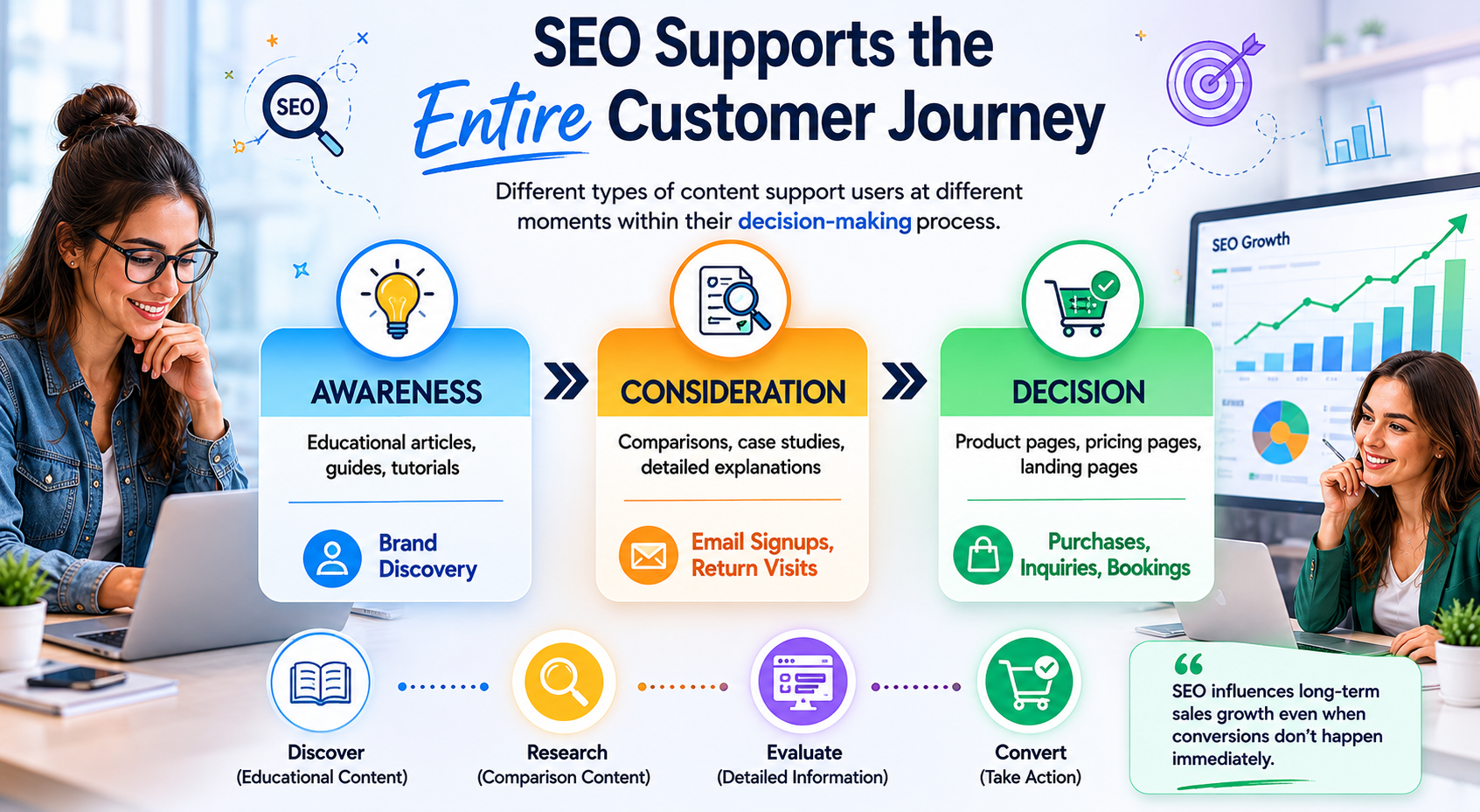
SEO Supports the Entire Customer Journey
SEO is not limited to a single stage of the conversion funnel.
Different types of content support users at different moments within their decision-making process.
| Customer Journey Stage | SEO Content Type | Potential Business Outcome |
|---|---|---|
| Awareness | Educational articles, guides, tutorials | Brand discovery |
| Consideration | Comparisons, case studies, detailed explanations | Email signups, return visits |
| Decision | Product pages, pricing pages, landing pages | Purchases, inquiries, bookings |
This is one reason SEO can influence long-term sales growth even when conversions do not happen immediately.
A user may first discover a website through an educational article, return later through a comparison search, and finally convert through a product or service page days or weeks later.
Search journeys are often multi-step rather than instant.
The Compounding Nature of SEO
One of SEO’s most important advantages is compounding growth.
Unlike short-term campaigns that stop producing results once spending ends, SEO assets can continue generating traffic over time.
As websites publish more high-quality content:
topical coverage expands
keyword visibility grows
internal linking strengthens relationships between pages
search engines gain more contextual understanding
authority signals accumulate
Over time, this creates a compounding effect where older content continues contributing to visibility while newer content expands reach further.
A website that consistently publishes valuable content within a specific topic area often begins ranking for:
broader keyword variations
long-tail searches
related semantic queries
informational and commercial searches simultaneously
This gradual accumulation is one of the reasons strong SEO strategies can produce sustainable lead generation systems.
SEO Helps Attract Qualified Visitors Instead of Random Traffic
Traffic volume alone does not guarantee business growth.
A website can receive large numbers of visitors while generating very few conversions if the audience lacks relevance.
Qualified traffic matters far more than raw traffic numbers.
SEO naturally filters visitors through search specificity.
For example:
A user searching “best payroll software for small law firms” is usually more qualified than someone casually clicking a generic advertisement without clear intent.
Long-tail searches often reveal:
stronger specificity
clearer motivation
defined problems
higher purchase readiness
This is why targeted SEO content frequently produces better lead quality.
Why Some Websites Get Traffic but No Leads
Many websites struggle because they focus on rankings without aligning SEO with user intent or conversion experience.
Common problems include:
Wrong Keyword Targeting
Some websites target broad keywords that attract irrelevant audiences.
For example, informational searches may generate traffic but not business opportunities if the content does not align with user goals.
Mismatched Search Intent
A transactional visitor landing on a purely educational page may leave without taking action.
Likewise, informational users may bounce from overly sales-focused pages.
Weak Trust Signals
Users often evaluate credibility quickly.
Poor design, outdated information, weak explanations, or inconsistent messaging can reduce trust.
Poor User Experience
Issues such as:
slow loading speeds
difficult navigation
intrusive popups
confusing layouts
poor mobile usability
can interrupt conversions even when rankings are strong.
Lack of Topical Depth
Websites with shallow content often struggle to establish authority.
Search engines increasingly evaluate whether websites demonstrate expertise across an entire subject area rather than isolated pages.
SEO and Trust Building Work Together
SEO is closely connected to trust development.
Users often associate search visibility with authority and credibility, especially when a website repeatedly appears for relevant searches.
Trust develops through multiple signals, including:
consistent visibility
helpful educational content
topical expertise
strong user experience
informational accuracy
clear website structure
Repeated exposure also matters psychologically.
When users encounter the same website multiple times across related searches, familiarity increases.
That familiarity can influence future engagement and purchasing decisions.
For example:
A business owner may first discover a website through an informational article about technical SEO problems.
Later, the same user may encounter that website again while researching content optimization strategies.
Over time, repeated exposure strengthens recognition and perceived expertise.
Informational Content Often Assists Future Sales
Not all conversions happen immediately.
Many users consume informational content long before they become customers.
For example:
Someone searching “how to improve ecommerce conversion rates” may initially want education rather than a purchase.
But if the content is genuinely useful, the user may later return through:
branded searches
direct visits
comparison searches
product-focused queries
This is one reason informational SEO content remains valuable even when immediate conversions are low.
Educational content builds familiarity and trust earlier in the customer journey.
Topical Authority Strengthens Commercial Visibility
Search engines increasingly evaluate websites based on topical expertise.
A website with deep, interconnected content around a subject often performs better than websites publishing isolated articles without semantic relationships.
For example:
A website covering:
search intent
technical SEO
content quality
internal linking
keyword cannibalization
indexing issues
user experience
creates stronger contextual authority than a website publishing disconnected SEO articles randomly.
As topical authority strengthens, websites may gain improved visibility for commercial and competitive searches as well.
This is because search engines become more confident that the website demonstrates expertise within the subject area.
Technical SEO Supports Lead Generation
Technical SEO affects how users and search engines interact with a website.
Even strong content can struggle if technical barriers create poor experiences.
Important technical factors include:
mobile usability
page speed
crawl accessibility
indexability
structured navigation
internal linking
website stability
Technical issues can reduce:
engagement
trust
discoverability
conversion opportunities
For example:
A slow-loading landing page may increase abandonment rates before users even engage with the content.
Likewise, indexing issues may prevent important pages from appearing in search results entirely.
User Experience Influences SEO and Conversions
Modern SEO and user experience are deeply connected.
Search engines increasingly prioritize pages that create positive experiences for users.
Helpful user experiences often include:
readable formatting
clear structure
logical navigation
mobile responsiveness
fast loading speeds
easy content accessibility
These improvements support both:
better engagement signals
stronger conversion potential
When users can quickly understand information and navigate pages easily, friction decreases throughout the customer journey.
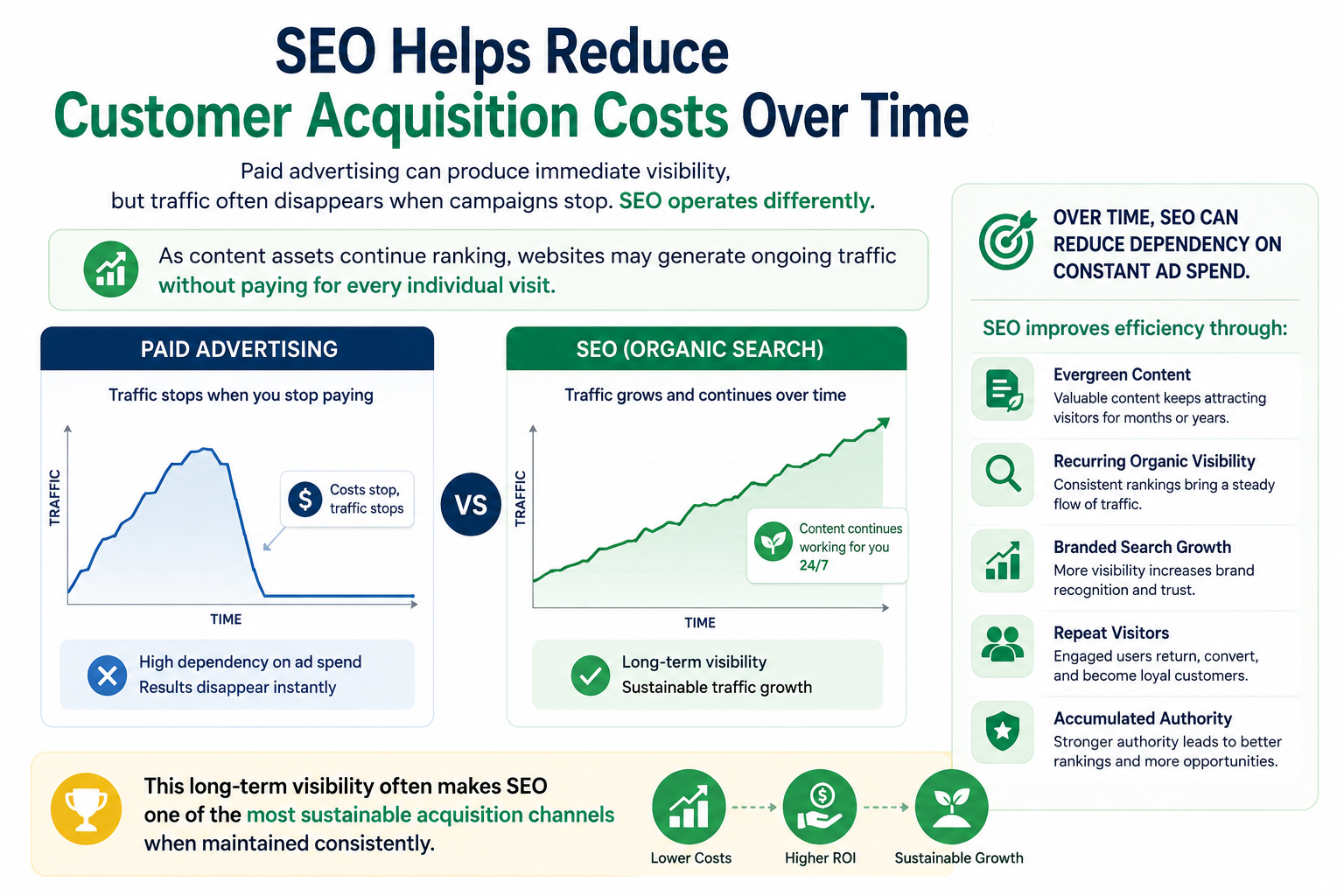
SEO Helps Reduce Customer Acquisition Costs Over Time
Paid advertising can produce immediate visibility, but traffic often disappears when campaigns stop.
SEO operates differently.
As content assets continue ranking, websites may generate ongoing traffic without paying for every individual visit.
Over time, this can reduce dependency on constant advertising spend.
SEO can also improve efficiency through:
evergreen content
recurring organic visibility
branded search growth
repeat visitors
accumulated authority
This long-term visibility often makes SEO one of the most sustainable acquisition channels when maintained consistently.
SEO Supports Brand Discovery and Brand Recall
Search engines are often the first place users encounter brands.
A website that consistently appears across informational and commercial searches gradually becomes more recognizable.
This contributes to:
brand familiarity
perceived expertise
branded search growth
repeat engagement
For example:
A user may repeatedly encounter the same website while researching SEO concepts over several weeks.
Eventually, that familiarity may influence which brand they trust most when making decisions later.
This demonstrates how SEO affects both immediate conversions and long-term brand positioning.
Why SEO Results Usually Take Time
SEO is a long-term process because search visibility depends on many interconnected factors.
These include:
content quality
topical authority
competition
backlinks
user experience
technical accessibility
search intent alignment
Search engines also need time to:
discover pages
evaluate relevance
measure engagement
understand semantic relationships
Because of this, SEO growth often happens gradually rather than instantly.
However, once authority and visibility strengthen, results can become increasingly sustainable.
Common Misunderstandings About SEO and Sales
Rankings Alone Do Not Guarantee Revenue
Strong rankings without intent alignment or conversion optimization may still produce weak business outcomes.
More Traffic Is Not Always Better
Relevant traffic with strong intent is usually more valuable than untargeted traffic at scale.
SEO Is Not Separate From Content Quality
Low-quality content limits both rankings and user trust.
SEO Is Not Only About Keywords
Modern SEO increasingly focuses on:
topical relevance
intent satisfaction
usability
content depth
entity relationships
Measuring SEO’s Impact on Leads and Sales
Businesses often evaluate SEO performance using metrics such as:
organic traffic
conversion rates
lead submissions
qualified inquiries
phone calls
sales attribution
landing page engagement
branded search growth
returning visitor behavior
These metrics help determine whether SEO efforts are attracting users with meaningful commercial relevance.
Final Thoughts
SEO helps businesses generate more leads and sales by connecting them with users actively searching for relevant information, products, services, or solutions.
Its value extends beyond rankings alone.
SEO influences:
trust
visibility
brand discovery
user experience
topical authority
conversion opportunities
long-term growth potential
When websites consistently publish useful, relevant, and trustworthy content, they build stronger relationships with both search engines and users.
Over time, this creates a sustainable ecosystem where visibility, authority, trust, and conversions reinforce each other.
Rather than functioning as a short-term traffic tactic, SEO becomes a long-term system for attracting qualified audiences and supporting meaningful business growth.
- content marketing
- content optimization
- conversion optimization
- organic leads
- organic traffic
- qualified traffic
- search engine optimization
- search intent
- seo
- SEO business growth
- SEO conversions
- SEO customer journey
- SEO lead generation
- SEO sales growth
- seo strategy
- SEO trust signals
- technical seo
- topical authority
- user experience
- website traffic