

Is SEO Worth It for Small Businesses?
-
nimda
- May 27, 2026
Small businesses operate in a highly competitive digital environment where visibility directly influences survival and growth. Every marketing decision must balance cost, sustainability, and long-term impact. One of the most debated questions in this context is whether SEO is actually worth the effort.
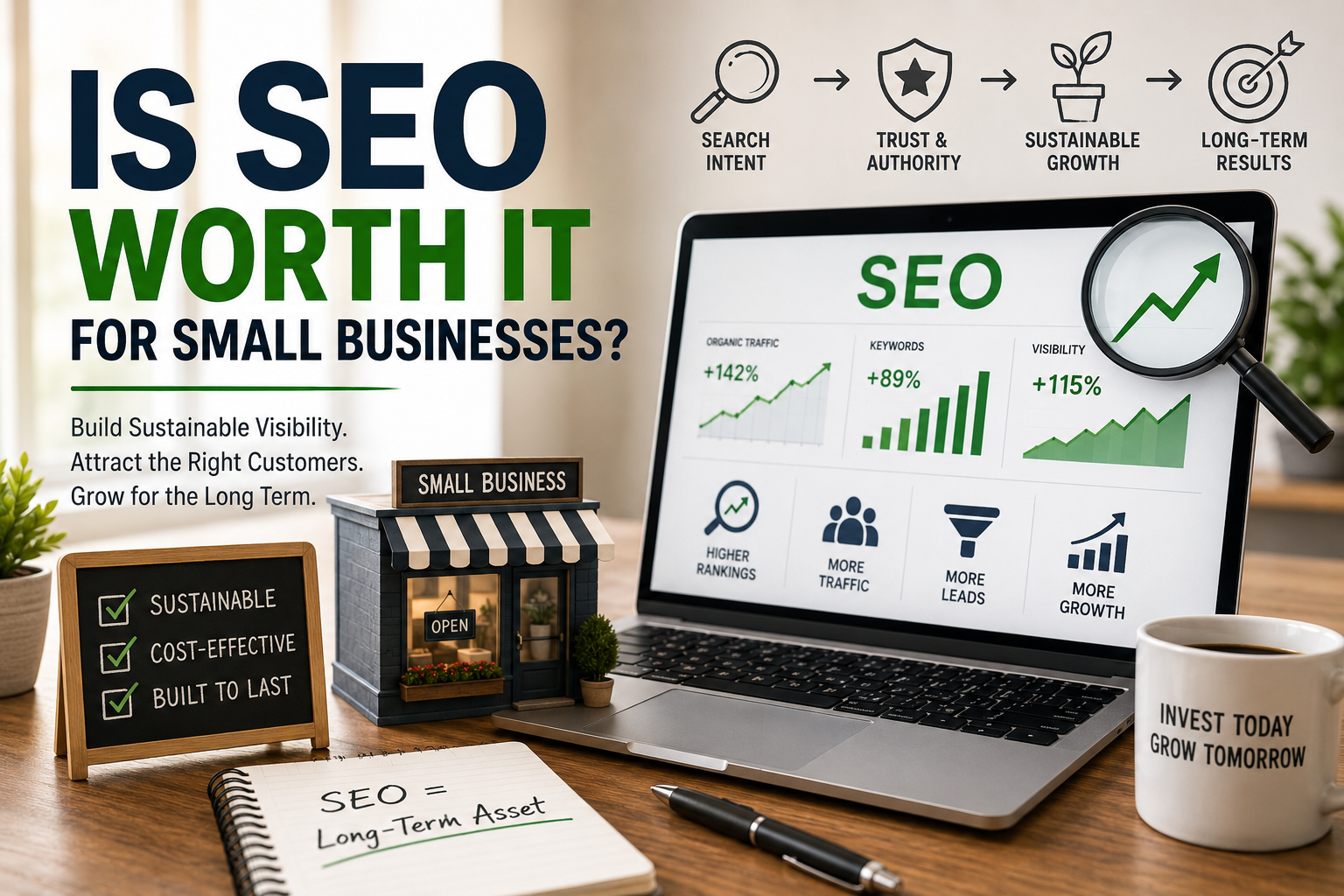
The honest answer is yes—but only when SEO is understood as a long-term visibility and authority system, not a quick traffic tactic.
SEO is not just about rankings. It is about how a business becomes discoverable, trusted, and consistently visible when people search with intent. For small businesses, this difference is critical because it shifts SEO from a “marketing expense” into a long-term digital asset.
Why Small Businesses Struggle With Online Visibility
Most small businesses rely heavily on fragmented visibility channels:
- Social media platforms
- Paid advertising
- Referrals and word-of-mouth
- Marketplaces or third-party platforms
- Occasional local exposure
These channels can work, but they all share a structural weakness: lack of control and inconsistency.
Social media visibility depends on algorithms. Paid ads require continuous spending. Referrals are unpredictable and unscalable.
Search engines operate differently because they respond to intent-driven demand rather than passive exposure.
SEO allows businesses to appear when users are actively searching for solutions, which creates a more stable and predictable visibility layer.
However, the deeper issue most small businesses face is not lack of marketing—it is lack of sustained discoverability.
What SEO Actually Does for a Small Business
SEO is a system that improves how search engines interpret, rank, and distribute website content.
But for small businesses, its impact extends beyond technical ranking factors.
1. Visibility in Intent-Driven Moments
SEO connects businesses to users at the exact moment they are searching for:
- solutions
- services
- comparisons
- information
- recommendations
This is fundamentally different from interruption-based marketing.
2. Trust Formation Through Search Presence
Users naturally trust organic results more than paid placements because organic visibility is perceived as earned relevance.
Repeated appearance in search results builds subconscious authority over time.
3. Compounding Traffic Systems
Unlike paid campaigns, SEO does not reset when budget stops.
Well-structured content can continue generating traffic months or even years after publication.
This creates a compounding visibility effect.
4. Knowledge-Based Customer Acquisition
SEO content often answers questions before a purchase decision is made.
This means businesses can influence users earlier in the decision journey.
5. Competitive Equalization
SEO allows smaller businesses to compete with larger brands by focusing on:
- relevance
- specificity
- topical depth
- intent alignment
Search engines do not reward size—they reward usefulness and clarity.
SEO Helps Capture Existing Demand
One of SEO’s strongest advantages is that it does not create demand—it captures it.
Users are already searching for:
- solutions to problems
- product comparisons
- service providers
- educational content
- decision guidance
This means SEO traffic is often pre-qualified and intent-rich.
For small businesses, this is more valuable than broad, untargeted visibility.
It is not about reaching more people—it is about reaching the right people at the right moment.
Local Search Changes the Equation
For businesses serving specific geographic areas, SEO becomes even more powerful due to local intent behavior.
Users frequently search for:
- nearby services
- opening hours
- pricing comparisons
- reviews and ratings
- best providers in an area
This creates a highly conversion-focused traffic environment.
Local SEO effectively turns search engines into discovery engines for real-world transactions.
Businesses in categories like healthcare, legal services, education, retail, hospitality, and home services often experience the strongest impact from local search visibility.
SEO vs Paid Advertising: Two Different Systems
SEO and paid advertising are often compared, but they operate on fundamentally different principles.
SEO | Paid Advertising |
Builds long-term visibility | Creates immediate exposure |
Compounds over time | Stops when budget stops |
Improves authority signals | Depends on bidding and spend |
Focuses on relevance | Focuses on placement |
Lower long-term cost efficiency | Higher ongoing cost dependency |
The key distinction is sustainability.
SEO builds digital assets. Paid ads rent attention.
The Cost of Ignoring SEO
A major blind spot for many small businesses is not what SEO provides—but what happens without it.
Ignoring SEO often leads to:
- increasing dependency on paid ads
- loss of organic discoverability
- stronger competitor dominance in search results
- reduced long-term traffic stability
- missed informational search opportunities
- weaker digital authority signals
Over time, this creates a situation where businesses must continually pay for visibility rather than earning it organically.
SEO Is a Long-Term Investment System
SEO does not behave like a traditional marketing channel.
It follows a delayed compounding model, meaning:
- early efforts may show limited results
- growth accumulates gradually
- authority builds over time
- visibility expands as content matures
Search engines evaluate websites based on:
- consistency
- relevance
- content depth
- user satisfaction signals
- technical accessibility
Because of this, SEO should be viewed as a long-term infrastructure investment rather than a short-term campaign.
Why SEO May Not Work for Some Small Businesses
SEO is powerful, but not universally effective in all contexts.
It may deliver limited results when:
1. Search Demand Is Extremely Low
If users are not actively searching for a product or service, SEO has limited surface area.
2. Website Foundations Are Weak
Poor structure, unclear content, or technical barriers reduce search engine understanding.
3. Expectations Are Unrealistic
Businesses expecting immediate results often misinterpret SEO’s timeline-based nature.
4. Competition Is Highly Established
In saturated markets, authority building requires more time and depth.
5. No Continuous Optimization Exists
SEO requires ongoing refinement, updates, and expansion.
SEO Is More Than Rankings
A common misunderstanding is that SEO success equals keyword rankings.
In reality, SEO influences broader digital systems:
- brand discovery
- informational visibility
- trust formation
- content accessibility
- topical authority development
- user experience alignment
Even when rankings fluctuate, these underlying improvements continue to create value.
Content Quality Is the Core Ranking Foundation
Modern SEO systems increasingly prioritize content that demonstrates:
- clarity of explanation
- depth of understanding
- relevance to user intent
- originality of insight
- structural coherence
Thin or repetitive content struggles because it does not provide meaningful informational value.
For small businesses, this creates an opportunity: high-quality educational content can outperform large brands that publish generic material.
Technical SEO Enables Visibility
Content alone is not enough if search engines cannot properly access or interpret a website.
Technical SEO influences:
- indexing efficiency
- crawl accessibility
- page performance
- internal structure clarity
- mobile usability
When technical foundations are weak, even strong content may remain under-visible.
SEO Compounds Over Time
One of SEO’s most powerful characteristics is its compounding nature.
As a website grows:
- more pages get indexed
- topical authority strengthens
- internal linking networks expand
- search visibility widens
- domain trust signals accumulate
This creates a self-reinforcing system where existing content enhances future performance.
Unlike most marketing channels, SEO improves with time rather than decaying.
Common Misunderstandings About SEO
“SEO is just keywords”
Modern SEO focuses on intent, relevance, and content systems—not keyword repetition.
“SEO guarantees rankings”
No legitimate system can guarantee rankings due to algorithmic variability.
“SEO is a one-time task”
SEO requires ongoing updates, optimization, and expansion.
“More content always means better SEO”
Quality and relevance matter more than volume. Poor content can weaken topical clarity.
SEO vs Platform Dependency
A critical modern insight is the difference between:
- owning visibility (SEO)
- renting visibility (social media, ads)
Platform-dependent businesses face risks such as:
- algorithm changes
- reach fluctuations
- rising ad costs
- audience volatility
SEO reduces this dependency by building search-based visibility assets that remain stable over time.
How Small Businesses Should Evaluate SEO
Instead of asking whether SEO is “worth it,” a better question is:
- Does my audience search for what I offer?
- Can I educate or inform through content?
- Do I need long-term visibility stability?
- Can I benefit from intent-driven traffic?
If the answer is yes, SEO becomes one of the most structurally valuable digital systems available.
Final Thoughts
SEO is worth it for small businesses when it is understood correctly.
Its real value lies in:
- sustainable visibility
- intent-based traffic acquisition
- long-term authority building
- compounding digital growth
- reduced dependence on paid channels
However, SEO is not instant or automatic. It requires consistency, strategic clarity, and long-term thinking.
Businesses that succeed with SEO are not those expecting quick wins—they are those building durable visibility systems that continue to generate value over time.
In modern search ecosystems, visibility is not just an advantage—it is infrastructure.
SEO helps small businesses build that infrastructure.