


-
nimda
- May 31, 2026
Understanding the Role of SEO in Modern Business Growth
Businesses today operate in an environment where consumers rely heavily on search engines to find information, compare options, research products, and make purchasing decisions. Regardless of industry, size, or business model, visibility in search results has become an important factor in attracting potential customers and maintaining long-term digital presence.
This is where Search Engine Optimization (SEO) becomes significant.
SEO helps businesses improve their visibility within search engine results, making it easier for users to discover relevant information when searching online. More importantly, SEO aligns business content with user needs, helping organizations become more accessible, trustworthy, and competitive in increasingly crowded digital markets.
Understanding why SEO matters requires looking beyond rankings and traffic. Its value extends into brand visibility, customer acquisition, user experience, market competitiveness, and sustainable growth.
The Shift in Consumer Behavior Toward Search
Search engines have become one of the primary tools people use when making decisions.
Before purchasing a product, hiring a company, visiting a location, or learning about a topic, users often begin with a search query. These searches represent real intent and frequently indicate a need, problem, question, or objective.
For businesses, this creates an opportunity.
When a website appears in search results for relevant topics, it becomes part of the customer’s decision-making journey. If it does not appear, potential opportunities may be lost to competitors who are more visible.
The importance of SEO is closely connected to this shift in consumer behavior. Businesses need discoverability where people actively seek information.
SEO Increases Search Visibility
One of the most fundamental reasons SEO matters is visibility.
A website that cannot be easily found through search engines faces significant limitations in attracting organic visitors. Even valuable products, services, or content may remain unnoticed if search engines struggle to understand or rank the website.
SEO improves visibility by helping search engines:
Discover website content
Understand page topics
Evaluate relevance
Match content with user searches
Present pages in appropriate search results
Greater visibility increases the likelihood that potential customers will encounter a business during relevant searches.
Visibility serves as the foundation upon which many other business benefits are built.
SEO Connects Businesses With User Intent
Not all website visitors have the same goals.
Some users want information.
Others want to compare options.
Some are ready to make a purchase or take action.
SEO helps businesses align content with different forms of search intent. By understanding what users are searching for and why they are searching, businesses can create content that addresses specific needs at various stages of the customer journey.
This alignment improves relevance, which benefits both users and search engines.
When content satisfies intent effectively, it often performs better in search results and creates a more positive user experience.
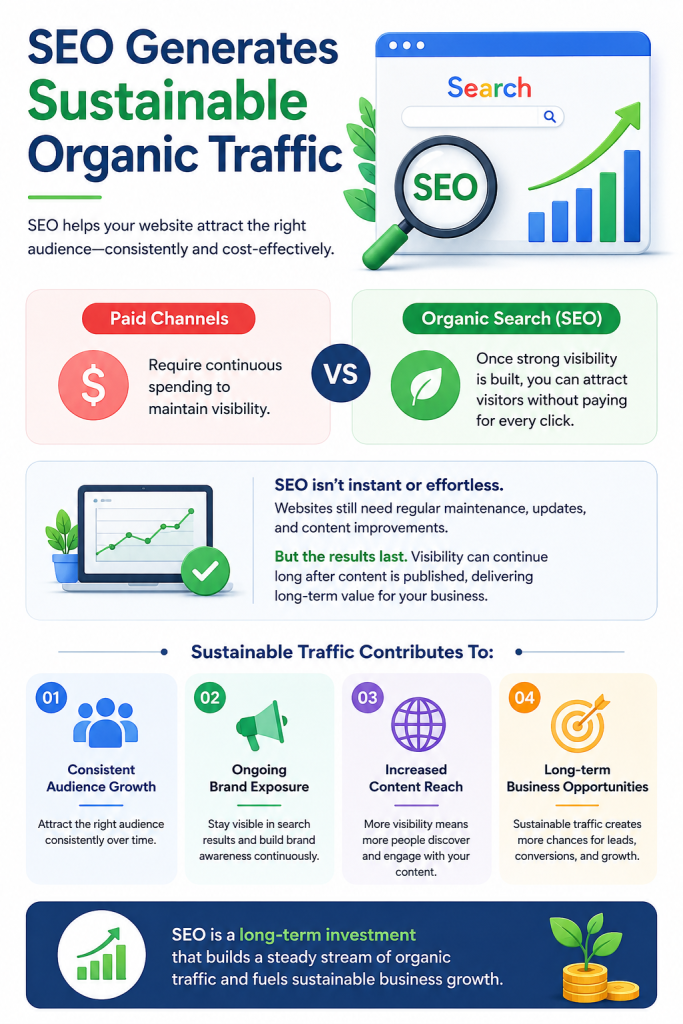
SEO Generates Sustainable Organic Traffic
Many digital channels require continuous spending to maintain visibility.
Organic search operates differently.
Once a website establishes strong visibility for relevant topics, it can continue attracting visitors without requiring payment for every click.
This does not mean SEO is effortless or automatic. Websites still require maintenance, updates, and content improvements. However, organic traffic often provides long-term value because visibility can persist long after content is published.
Sustainable traffic contributes to:
Consistent audience growth
Ongoing brand exposure
Increased content reach
Long-term business opportunities
For many organizations, this makes SEO an important component of digital growth strategies.
SEO Supports Brand Awareness
Users frequently encounter brands through search results before they become customers.
Appearing consistently across relevant searches increases familiarity and recognition. Even when users do not immediately take action, repeated exposure can strengthen brand awareness over time.
Search visibility helps businesses establish a presence within their market by positioning content where audiences naturally seek information.
This visibility contributes to brand development because users often associate prominent search presence with authority and credibility.
The more frequently a business appears for relevant topics, the more opportunities it has to become recognizable within its industry.
SEO Builds Trust and Credibility
Trust plays a critical role in business success.
Search engines aim to provide users with reliable, relevant, and high-quality information. As a result, websites that demonstrate expertise, usefulness, and credibility often gain stronger visibility.
Several factors influence how users perceive trustworthiness, including:
Content quality
Website usability
Accurate information
Consistent publishing
Secure browsing experiences
Positive reputation signals
While trust is earned over time, SEO encourages many of the practices that contribute to credibility.
Businesses that invest in improving content quality and user experience often strengthen both search performance and audience confidence.
SEO Enhances User Experience
SEO is not solely about search engines.
Modern SEO increasingly overlaps with user experience.
Search engines reward websites that provide accessible, useful, and efficient experiences for visitors. Factors such as page speed, navigation, content organization, and mobile usability all influence how users interact with a website.
When users can quickly find information and complete desired actions, engagement often improves.
Better user experiences may contribute to:
Longer visit durations
Lower bounce rates
Increased interaction
Improved satisfaction
These outcomes benefit businesses while also supporting broader SEO objectives.
SEO Helps Businesses Stay Competitive
In many industries, competitors are already investing in search visibility.
If one business appears prominently in search results while another remains difficult to find, the more visible organization often gains a significant advantage in attracting attention.
SEO helps businesses compete within their market by increasing discoverability and improving content relevance.
Competitive advantages gained through SEO may include:
Greater market exposure
Increased audience reach
Improved information accessibility
Stronger digital presence
Businesses that ignore search visibility may find it increasingly difficult to compete as digital competition grows.
SEO Supports the Entire Customer Journey
Customers rarely move directly from awareness to purchase.
Most journeys involve multiple stages of research, evaluation, and decision-making.
SEO allows businesses to create content that serves users throughout this process.
Examples include:
Awareness Stage
Users seek information and answers.
Content often includes:
Educational articles
Guides
Explanations
Definitions
Consideration Stage
Users compare options and evaluate solutions.
Content often includes:
Comparisons
Reviews
Case examples
Detailed analyses
Decision Stage
Users are prepared to take action.
Content often includes:
Product information
Service details
Pricing resources
Transaction-focused pages
By supporting multiple stages, SEO helps businesses remain visible throughout the customer journey rather than only at the final decision point.
SEO Provides Valuable Audience Insights
Search behavior reveals what people want to know.
Keyword research, search trends, and content performance data provide insight into audience interests, concerns, and priorities.
Businesses can use these insights to better understand:
Customer questions
Industry trends
Emerging topics
Demand patterns
Information gaps
This knowledge can influence content creation, product development, customer support strategies, and broader business decisions.
SEO therefore functions as both a visibility strategy and a source of market intelligence.
SEO Expands Digital Content Reach
Content has limited value if audiences never discover it.
SEO helps distribute content by increasing its visibility in search results where users actively seek information.
Whether a business publishes:
Articles
Research
Resources
Product pages
Educational content
SEO improves the likelihood that these assets will reach relevant audiences.
As content visibility grows, businesses gain additional opportunities to educate users, establish authority, and strengthen relationships with potential customers.
SEO Contributes to Long-Term Business Growth
One reason SEO remains important is its cumulative nature.
Each optimized page, useful article, and improved user experience contributes to a larger digital ecosystem.
Over time, businesses can build:
Greater topical authority
Larger content libraries
Stronger search visibility
Broader keyword coverage
Increased audience trust
These assets often create compounding benefits that support growth beyond individual campaigns or short-term marketing initiatives.
Rather than focusing solely on immediate outcomes, SEO helps build a foundation for sustained digital presence.
Common Misconceptions About SEO
Several misconceptions often create unrealistic expectations.
SEO Is Not Only About Rankings
Rankings matter, but visibility alone does not guarantee business success.
Effective SEO focuses on relevance, user satisfaction, and meaningful engagement.
SEO Is Not Instant
Building visibility often takes time.
Search engines need opportunities to discover, evaluate, and understand content before significant results emerge.
SEO Is Not Just Keywords
Modern SEO involves much more than keyword placement.
Content quality, user experience, search intent alignment, website accessibility, and topical relevance all play important roles.
SEO Is Not a One-Time Task
Search behavior, competition, and search algorithms continue evolving.
SEO requires ongoing attention to maintain and improve performance over time.
The Future Importance of SEO
As digital information continues expanding, search engines remain essential tools for navigating online content.
Businesses that understand how users search, consume information, and make decisions are better positioned to remain visible and relevant.
While technologies evolve, the fundamental need to connect people with useful information is unlikely to disappear.
SEO supports this connection by helping businesses present valuable content in ways that search engines and users can easily understand.
Its importance continues to grow as competition for online attention increases.
Final Thoughts
SEO matters for businesses because it improves visibility, connects organizations with user intent, supports trust building, enhances user experience, and contributes to sustainable long-term growth.
More than a tactic for improving rankings, SEO serves as a framework for making information easier to discover, understand, and use. It helps businesses participate in the moments when customers actively seek answers, solutions, products, and services.
As search engines remain a central part of how people navigate the internet, businesses that prioritize search visibility and content relevance are better equipped to build awareness, strengthen authority, and create lasting digital presence.
- brand awareness
- business growth
- business visibility
- customer acquisition
- long term business growth
- long term seo
- online visibility
- organic growth
- organic traffic
- search engine optimization
- search marketing
- search performance
- search rankings
- search visibility
- seo benefits
- seo for businesses
- seo importance
- seo strategy
- sustainable growth
- topical authority
- user intent
- website optimization
- website traffic
- why seo matters for businesses